

A Labradoodle’s coat needs a routine, not an occasional rescue. For a longer coat, plan a clip every 6-8 weeks, with regular brushing between appointments; a bath every 4-6 weeks is a useful guide. To learn how to groom a Labradoodle at home, begin with brushing before bathing, then dry the coat thoroughly and comb through it to catch tangles early.
That steady care can feel like a lot, especially when curls knot easily or your dog wriggles through brushing. The right tools, a gentle sequence and a manageable trim make the job calmer for both of you. This guide explains how often to brush and bathe, which brushes and combs suit different coats, and how to choose between practical cuts such as a teddy bear or summer clip. You’ll also learn where at-home grooming is best kept simple, so coat care feels like a comfortable ritual rather than a rushed wrestle.
Key Takeaways
- Keep a longer coat manageable with regular brushing between clips, which are generally needed every 6-8 weeks. Bathe every 4-6 weeks and dry thoroughly after swimming.
- Match brushing frequency to coat type: wool coats need daily attention, while fleece coats benefit from brushing 3 to 4 times a week.
- Choose tools and grooming sessions around your Labradoodle’s coat and size; a smaller dog’s brushing routine may take less time than a standard-sized dog’s.
- Pick a practical cut for your dog’s lifestyle: a teddy bear trim keeps more length, while a summer or kennel cut is shorter and easier to maintain.
How often does a Labradoodle need to be Groomed?
For a longer coat, schedule a clip every 6-8 weeks and brush regularly between appointments. Bathe about every 4-6 weeks, or sooner when your dog is especially dirty. Inspect the ears inside the flap weekly for redness, smell or wax; clean them as needed with an appropriate ear-cleaning solution, massaging it for 15-30 seconds before wiping. Nail length varies, so ask a groomer or vet to demonstrate safe trimming before trying it at home. Shaving too close or using clippers without control can nick or irritate skin, so keep the blade away from folds and stop if your dog moves suddenly.
- Brush before bathing. Work through the coat first to remove loose hair and locate knots. Pay attention to the fleece behind the ears, under the legs and around the collar, where tangles can hide. Don’t soak a mat: water can tighten it against the coat and make it harder to ease apart.
- Use dog shampoo. Regular human shampoo isn’t suitable because dogs have a different skin pH. Choose shampoo and conditioner made for dogs, then rinse thoroughly so residue doesn’t remain against the skin. Follow the product directions, especially if your Labradoodle has sensitive skin.
- Rinse after swimming. After a swim, rinse the coat with fresh water to remove pool or seawater. Gently squeeze out excess water with a towel rather than rubbing curls into knots. Dry the coat fully, then comb through it to find any tangles before they tighten.
- Keep clipping and scissor work measured. Fleece or wool coats generally need clipping every 6-8 weeks; a much shorter coat may go 8-10 weeks or longer between clips. If you use scissors, choose rounded-tip grooming scissors and trim only where you can clearly see the skin and coat. Avoid delicate areas if your dog won’t stay still.
Brushes, combs and grooming tools
Choose tools that suit your Labradoodle’s coat and use them in a calm, consistent sequence. A slicker brush, metal comb and detangling spray can help make home grooming more manageable.
-
Choose brushes and grooming tools
Start with a slicker brush to separate curls, then use a metal comb to check your work. Choose tools that feel comfortable in your hand and glide through the coat without scratching the skin. Keep detangling spray nearby for knots. Never force a comb through a mat or pull hard, as this can make grooming uncomfortable.
-
Set a brushing schedule and technique
Set the schedule around coat type: brush wool coats daily, fleece coats 3 to 4 times a week, and hair coats twice a week. For other coats, brushing 2-3 times every week helps manage tangles. Begin gently at the feet and work upwards, checking friction points such as the collar area. Puppy handling and gentle brushing can start from 8-10 weeks old.
-
Brush and detangle the coat
Work in small sections, holding the coat near the skin to reduce pulling. If a knot catches, apply detangling spray and loosen it gently with your fingers before using the slicker brush. Follow with the comb to find hidden tangles. This steady approach makes it easier to groom a Labradoodle at home without rushing through knots.
-
Use the line brushing technique
Part the coat horizontally and brush a narrow line from the skin outwards. Move the part gradually across the body, then repeat on the legs, chest and floppy ears. Check each section with the comb before moving on. A standard wool-coated Labradoodle can take 30 to 45 minutes of proper line brushing; a miniature may take 10 to 15 minutes. Follow this sequence whenever you practise how to groom a Labradoodle at home.
For knots that need extra slip, use a dog detangling spray as part of your brushing routine.
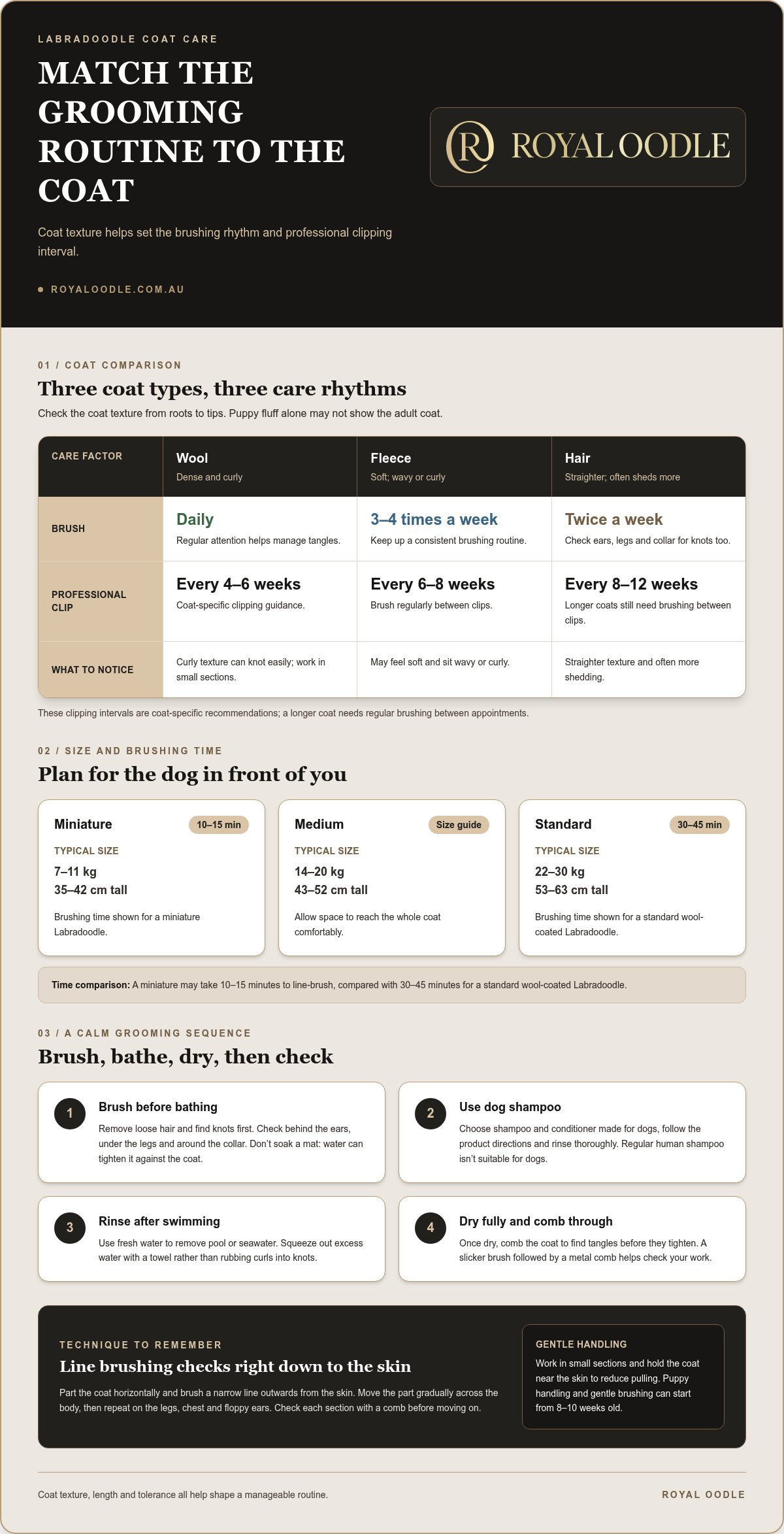
Labradoodle size and coat-type differences
Identify your Labradoodle’s coat texture and adult size before setting a grooming routine. In Australia, Labradoodles vary in both, so match coat care to what grows from your dog’s skin.
-
Identify the Labradoodle coat type
Part the coat and examine its texture from roots to tips. A wool coat is dense and curly; a fleece coat feels softer and may be wavy or curly; a hair coat is straighter and often sheds more. These differences reflect Labrador retriever and poodle ancestry. Don’t judge by puppy fluff alone, as the adult coat can change as your dog matures.
-
Match grooming needs to coat type
Set brushing and clipping around the coat you see. Brush wool coats daily, fleece coats 3 to 4 times a week, and hair coats twice a week. Professional clipping recommendations differ too: wool coats need attention every 4 to 6 weeks, fleece coats every 6 to 8 weeks, and hair coats every 8 to 12 weeks. Longer coats need regular brushing between clips.
- Use your dog’s size to plan the time and handling required. A miniature Labradoodle is typically 7 to 11 kg and 35 to 42 cm tall; a medium is 14 to 20 kg and 43 to 52 cm. A standard Labradoodle is 22 to 30 kg and 53 to 63 cm tall. These ranges help you prepare a stable grooming space and reach the whole coat comfortably.
- Adjust the routine to coat length and your dog’s tolerance. A shorter coat is easier to brush through, but still check for knots around the ears, legs and collar. For a longer fleece or wool coat, brush in manageable sections and keep to a consistent routine. Make sessions calm, especially for a young dog still learning to stand for grooming.
Teddy bear, summer or kennel, and lamb cuts
Choose a cut based on coat length, upkeep and your Labradoodle’s comfort. Before trimming at home, brush and dry the coat, work in small sections, and use scissors only where you can clearly see the coat and skin.
-
Follow teddy bear clip guidance
Ask for or plan a teddy bear shape, with the coat usually kept 2 to 4 cm long all over. Comb each section before trimming so curls sit naturally, then even the body gradually. Keep the face soft and rounded, checking both sides for balance. This cut retains more length than a summer or kennel clip, so it needs consistent brushing to prevent tangles.
-
Trim the coat at home step by step
Prepare a clean, dry, thoroughly brushed coat and choose a style before switching on clippers. Move slowly in the direction of coat growth, taking care around skin folds. Use scissors around the face only when your dog is settled, and stop if they wriggle.
- Choose a length. A summer or kennel cut usually leaves 1 to 2 cm on the body. It can suit active dogs and is easier to maintain at home.
- Clip the body evenly. Work in sections, checking the coat length as you go. Don’t press the clipper hard against the skin.
- Shape the head and ears. For a full clip, leave about 5-7 cm on top of the head, layer the outside of the ears to about 3 cm, and shape the beard and moustache to around 3-4 cm.
- Finish with a comb check. Comb through the coat and tidy uneven edges. A lamb cut can keep the body shorter while leaving the legs fuller, but even proportions take careful trimming.
For a comfortable finish between trims, explore coat-care products for Labradoodles.
Royal Oodle: Detangling Sprays
Royal Oodle’s Detangling Sprays can be a useful addition when curls snag during regular brushing. Apply a suitable detangling spray to a knot, ease it apart gently with your fingers, then work through with a comb rather than pulling at the coat. For bath days, dog-specific Shampoo & Conditioners support the washing and conditioning steps in your routine. Royal Oodle’s grooming products are designed for Oodles and other curly-coated dogs, with gentle formulations for sensitive skin. Choose the product that fits the task: detangling between baths or cleansing during a wash. If you’d like help choosing a coat-care option for your Labradoodle, contact Royal Oodle.
Make the next grooming session feel easier
Use each grooming session to build familiarity, not just polish the coat. Keep the space calm, let your Labradoodle settle beside the tools, and pause when they need a moment. Learning how to groom a Labradoodle at home also means noticing what makes your dog comfortable and shaping the routine around those cues. A relaxed approach can make handling more predictable over time.
For coat care between trims, Royal Oodle offers Detangling Sprays, Shampoo & Conditioners, and Bundles & Kits. Choose what suits your routine, whether you’re easing through knots or preparing for bath day.
Ready to make coat care feel more considered? Explore Royal Oodle’s coat-care range and choose a thoughtful next step for your Labradoodle. Each gentle session is a chance to make grooming a more comfortable part of life together.
Frequently Asked Questions
What do I need?
Gather a slicker brush, metal comb, dog shampoo and conditioner, towels, and grooming scissors before you start. Detangling spray can help with knots, while a non-slip surface gives your dog a steadier place to stand. Keep supplies within reach so you don’t need to leave your Labradoodle unattended on a raised surface. Introduce each tool calmly and let your dog sniff it first.
How often should you brush a Labradoodle at home?
Set the schedule according to coat texture: wool coats need daily brushing, fleece coats benefit from brushing 3 to 4 times a week, and hair coats need brushing twice a week. For a dog with mixed textures, give extra attention to curlier patches and friction areas. Short, regular sessions can be easier to maintain than one long session after tangles have formed.
How often should you bathe a Labradoodle, and what shampoo is safe?
A bath every 4-6 weeks is a useful guide, with an earlier wash if your dog gets especially dirty. Choose shampoo made for dogs rather than regular human shampoo, as dogs have a different skin pH. Rinse carefully beneath the belly and around the legs, then dry the coat fully. After swimming, rinse with fresh water before drying and combing through.
How do you prevent and remove Labradoodle mats safely?
Check behind the ears, beneath the collar and between the legs while brushing, as these areas can trap knots. For a small tangle, apply detangling spray, loosen it gently with your fingers, then comb from the ends towards the roots. Don’t yank or cut close to the skin. If a mat is tight against the skin, don’t try to force it apart with scissors.
What grooming tools do you need for a Labradoodle?
A slicker brush separates curls, while a metal comb helps reveal knots hidden beneath the topcoat. Use rounded-tip grooming scissors for small tidy-ups only where the coat and skin are easy to see. Dog shampoo and conditioner are useful for bath days. Before grooming your Labradoodle at home, arrange your tools within reach so you don’t have to leave your dog unattended on the grooming surface.
How do you groom a Labradoodle’s face, ears, paws and sanitary areas?
Comb facial hair away from the eyes and trim only visible ends, keeping scissors well clear of a moving dog. Check inside the ear flap regularly for redness, smell or wax. Keep paws and sanitary areas tidy with controlled trimming, and stop if your Labradoodle wriggles. For nail trimming, ask a groomer or vet to demonstrate the technique before attempting it yourself.
