

What if your Oodle’s knots aren’t a sign you’re brushing badly, but the result of several coat conditions working together? If you’ve wondered, “why does my oodle's fur get so knotty”, you’re not alone. Tangles that return soon after brushing can be frustrating, especially when you’re trying to keep grooming gentle and comfortable.
Oodle coats can combine curly or wavy hair with loose shed hair that gets caught instead of falling away. Everyday friction from collars, harnesses and play, as well as moisture from rain, swimming and baths, can help small tangles tighten. A coat change as your puppy grows can make knots more likely, too.
This guide explains why Oodle fur tangles, which habits and conditions can make knots worse, and how to care for the coat with less brushing friction. You’ll also learn how detangling products can support a consistent routine, why they can’t address every cause on their own, and when a dense mat needs careful professional attention rather than forceful brushing.
Key Takeaways
- Understand why Oodle fur gets knotty by looking at how coat texture, length and everyday movement interact.
- Spot common knot triggers, including dampness, friction and areas that are easy to miss during brushing.
- Learn to recognise when a loose tangle has become a dense mat that needs careful attention.
- Use a gentle, consistent care sequence to address loose tangles without forcing a brush through the coat.
- Treat recurring knots as useful clues about your Oodle’s coat and grooming routine, not a reason to blame yourself.
Why Does an Oodle’s Fur Get Knotty So Easily?
Recurring knots are common in Oodle coats and don’t automatically mean you’ve neglected your dog. A knot forms when hairs become intertwined. A loose tangle may separate with gentle care, while a mat is a tighter, compacted clump that can sit close to the skin and become uncomfortable.
In brief: Oodle coats can knot readily because curls and waves catch loose hairs, while movement, friction and moisture can twist those hairs into tighter tangles. Because these causes often overlap, brushing can help one day without preventing knots from returning.
How Oodle coat texture encourages tangles
Oodles can inherit different coat textures from their Poodle and other-breed parentage. Some coats are wavy, some curlier, and others combine textures or have longer sections. As a result, two dogs of the same Oodle cross may need different coat care.
Waves and curls bend strands back towards neighbouring hairs, creating more opportunities for them to catch and twist than in straighter coats. Longer sections add to this: loose strands have more length to wrap around nearby hair. The risk depends on your dog’s individual coat, not simply whether they’re a Cavoodle, Groodle or Labradoodle.
Why loose hairs can stay caught in the coat
Some shed hairs fall away freely, while others remain held within a curly coat. The Poodle coat characteristics include tight curls that can slow the release of dead hair, helping explain why loose strands may stay among the coat instead of landing on the floor.
As your dog walks, plays or settles down, retained hair moves against surrounding strands. It can wind around them, especially where the coat is longer or more textured. Shedding patterns vary between individual dogs, so the amount of loose hair caught in the coat differs, too.
Moisture and repeated rubbing can make tangles harder to loosen. Damp hairs may cling together, while friction from ordinary movement can tighten an existing knot. A small tangle can become denser over time. That’s why brushing frequency alone doesn’t always explain recurring knots: coat texture, loose hair and daily conditions all play a part.
How Coat Length, Curl and Loose Hair Combine to Create Knots
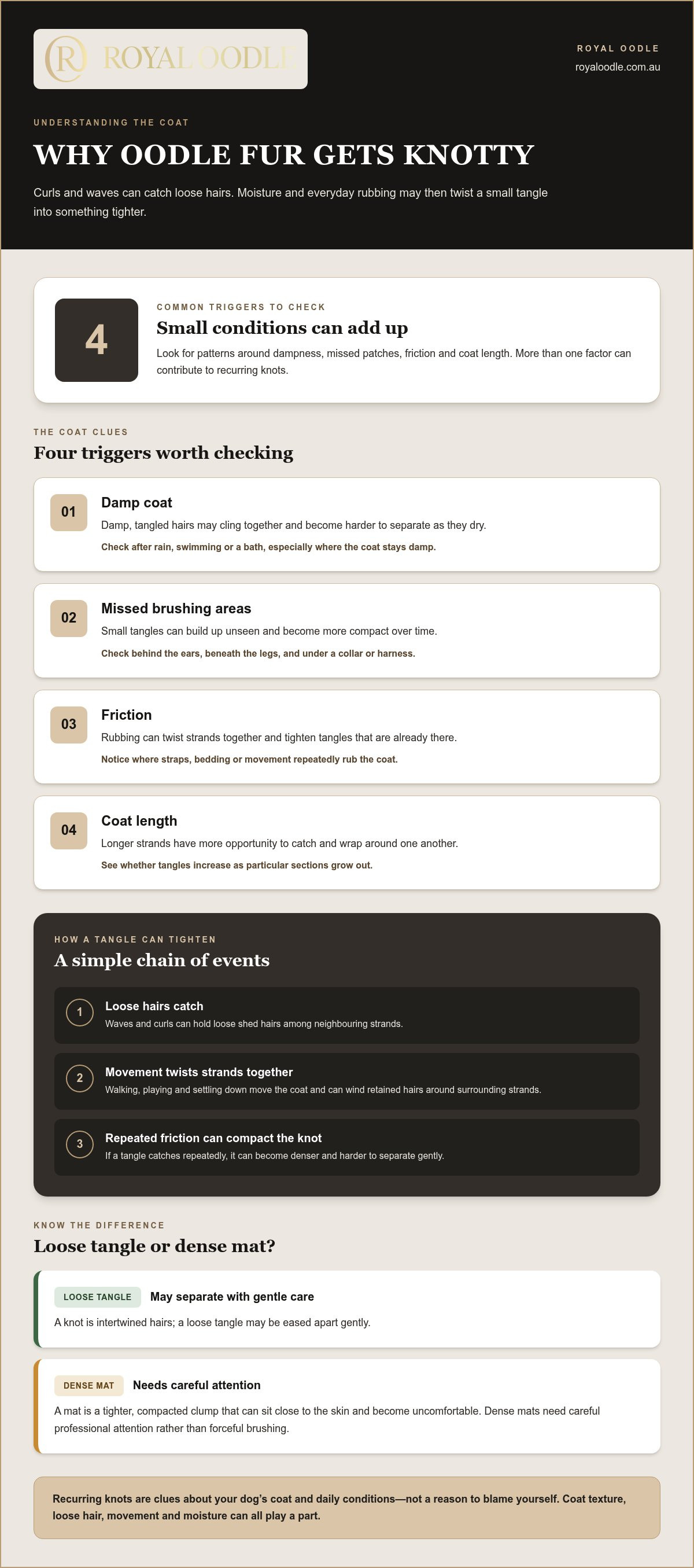
Knots usually form through a chain of small events. Loose hairs catch between neighbouring strands. Walking, playing and settling down move the coat, twisting those strands together. If the tangle catches repeatedly, it can tighten and become harder to separate gently.
Retained shed hair and repeated friction can turn a small tangle into a compact mat. Coat length affects how readily strands wrap around each other. Longer hairs have more opportunity to loop, cross and snag, particularly where they rub against skin, equipment or bedding.
Why curls and coat length change the knotting risk
Straighter hair may allow loose strands to fall away more readily, while waves and curls can hold them within the coat. That doesn’t mean a straight coat can’t tangle or that every curly coat will mat. The pattern, density and length of an individual dog’s coat all affect how strands move and catch.
Longer sections can intertwine as your dog moves, especially if they’re curly or mixed in texture. Some Oodles have different textures across the body, and a coat can change as the dog grows. Grooming needs can therefore vary between dogs, even within the same cross. Veterinary guidance such as Grooming and Coat Care for Your Dog also emphasises choosing care suited to the coat type.
Where everyday friction often starts tangles
Check common rubbing points: behind the ears, under the collar, beneath harness straps and around the legs. A collar can shift as your dog walks, harness straps move against the coat, and the legs brush together during movement. Bedding, rolling during play and handling can also create repeated friction in the same areas.
These spots are useful clues, not proof that you’ve done anything wrong. If knots keep appearing in one place, consider what regularly touches or presses against that part of the coat. Longer hair can make the effect more noticeable, while dampness can make existing tangles harder to loosen. Several factors may contribute at once.
Understanding the source helps you make coat care more comfortable. Detangling products can help reduce brushing friction, but they won’t remove every cause of knotting. For a considered routine, explore Oodle coat-care products, including detangling sprays developed for curly-coated dogs.
What Makes Oodle Fur Knot Faster? Common Triggers to Check
If you’re asking, “why does my oodle's fur get so knotty”, look beyond brushing alone. Dampness, missed patches, rubbing and changes to coat length or routine can all help a small tangle tighten. Use these clues to spot patterns, not to blame yourself.
| Trigger | What it can do to the coat | What to notice |
|---|---|---|
| Damp coat | Damp, tangled hairs may cling together and become harder to separate as they dry. | Check after rain, swimming or a bath, especially where the coat stays damp. |
| Missed brushing areas | Small tangles can build up unseen and become more compact over time. | Look for recurring knots behind the ears, beneath the legs and under a collar or harness. |
| Friction | Rubbing can twist strands together and tighten existing tangles. | Notice whether knots appear where straps, bedding or movement repeatedly rub the coat. |
| Coat length | Longer strands have more opportunity to catch and wrap around one another. | See whether tangles increase as particular sections grow out. |
| Changes in grooming frequency | Longer gaps between coat checks can give loose tangles time to accumulate. | Consider whether knots appeared after a change in your usual care routine. |
Can moisture and washing contribute to tangles?
Bathing doesn’t explain every knot, and skipping washes isn’t a general solution. But if a coat is already tangled, moisture and drying may make those strands harder to separate. After washing or getting wet outdoors, handle the coat gently and dry it thoroughly in a way that suits your dog’s coat and comfort. Avoid rough rubbing, which adds friction.
Shampoo and conditioner are one part of wash care. For guidance on choosing products for curly coats, read this Oodle shampoo guide.
How routine and coat changes affect knotting
When coat checks happen less often, small tangles may go unnoticed until they’re harder to loosen. Your dog’s needs can also shift as a soft puppy coat gives way to an adult coat, or after a trim changes the length and texture you’re managing. Clipping doesn’t guarantee fewer knots. Notice how the coat behaves afterwards and adjust your care routine to keep it comfortable and manageable.
How to Tell a Small Tangle from a Serious Mat
A small tangle is usually visible and loose enough to separate gently, with some movement between the hairs. A serious mat feels dense and compacted. It may sit close to the skin, resist gentle separation and tug on the skin when your dog moves. If you’re still wondering, “why does my oodle's fur get so knotty”, recognising when a tangle has become a mat is an important part of comfortable coat care.
Signs a knot may need more than gentle home care
Pause if a knot feels tight, lies close to the skin or won’t ease apart with gentle handling. Your dog’s response matters, too. Flinching, repeatedly licking the area, turning away or resisting touch can signal discomfort. Don’t keep brushing to see if it will eventually loosen.
Seek help from a qualified groomer if mats are extensive or difficult to manage safely. If the skin appears affected, or you notice redness, an unpleasant odour, trapped moisture or restricted movement, contact a veterinarian for advice. These signs don’t identify a specific skin problem on their own, but they warrant attention. Pain, wounds or sudden changes to the coat are also reasons to seek veterinary advice.
Why forceful detangling and scissors can be risky
It can be tempting to pull a stubborn knot apart or snip it out. Dense mats can draw skin up inside the clump, making it hard to see where the coat ends and the skin begins. Cutting close to the skin risks injury, while yanking or repeatedly brushing a sore area can increase discomfort.
Keep the distinction simple: if a loose tangle separates easily and your dog stays relaxed, gentle handling may be appropriate. If the coat resists, your dog shows distress or you can’t see the skin clearly, stop. Avoid forcing a brush through or using scissors close to the skin. A detangling spray can help reduce friction during routine coat care, but it isn’t a solution for every mat or a substitute for professional help when a mat is severe.
For gentle support with everyday detangling, explore detangling coat-care products designed for Oodles and other curly-coated dogs.
Reduce Recurring Oodle Knots with Gentle, Consistent Coat Care
A comfortable routine doesn’t need to be perfect or follow the same schedule for every Oodle. If you’ve been asking, “why does my oodle's fur get so knotty”, use recurring knots as clues. Note where they form, what has been rubbing against the coat and whether dampness or a change in routine may be involved.
Build a simple coat-check habit
Make brief coat checks part of your regular care. Pay particular attention behind the ears, beneath collar or harness straps, and around the legs, where friction can encourage tangles. If your dog has recently been wet, check that the coat has dried fully and whether existing knots feel tighter.
Keep track of patterns. A knot that repeatedly appears beneath a harness may point to rubbing; tangles across longer sections may call for closer, more consistent checks. Adjust your approach to your dog’s coat texture and length, and pay attention to their comfort. If they flinch or resist, pause rather than turning care into a struggle.
Choose gentle support for easier brushing
For loose tangles, a suitable detangling spray may help reduce friction as you work through the coat gently. Conditioners can also be part of a considered coat-care routine. Royal Oodle offers detangling sprays and conditioners designed for Oodles and other curly-coated dogs. No product can address every cause of knotting or safely resolve a dense mat close to the skin.
For more detail on what to consider when selecting a spray, read the dog detangling spray guide. If a knot resists gentle handling or your dog seems uncomfortable, stop and seek suitable grooming or veterinary help rather than forcing it apart.
Keep the routine calm and manageable: check the friction points, gently address loose tangles, then consider what may be causing knots to return. For gentle, consistent care between washes, explore Royal Oodle coat care.
Make Oodle Coat Care Feel More Manageable
If you’ve wondered “why does my oodle's fur get so knotty”, the answer is often a combination of coat texture, retained loose hair, friction and moisture. Small tangles can tighten into mats, so notice where knots return and respond gently rather than forcing a brush through. A calm, consistent routine tailored to your dog’s coat and comfort can make care feel easier, without expecting perfection or a one-size-fits-all schedule.
Detangling sprays, shampoos and conditioners can support comfortable coat maintenance, but a dense, painful mat may need careful professional attention. Royal Oodle’s grooming products are designed for Oodles and other curly-coated dogs, and developed and manufactured in Australia. The range includes detangling sprays, shampoos, conditioners and kits to support different parts of your care routine.
Explore Royal Oodle’s coat-care products for gentle support with your dog’s routine. With patient handling and care that suits your Oodle, grooming can become a more comfortable moment together.
Frequently Asked Questions
Why does my Oodle’s fur get knotty so quickly?
Oodle fur can knot quickly because curls or waves may hold loose hairs, while everyday movement and rubbing twist strands together. Collar and harness contact, bedding, coat length and dampness can all contribute. If you’re asking “why does my oodle's fur get so knotty”, remember that recurring knots don’t automatically mean you’re doing something wrong. Notice where tangles return to help identify what’s contributing.
Can loose hair cause knots in an Oodle’s coat?
Yes, loose hairs can become caught among neighbouring strands, particularly in wavy or curly coats. Rather than falling away freely, they may stay within the coat and twist around other hairs as your dog moves. Shedding and coat texture vary between individual Oodles, so dogs won’t all shed or mat in the same way. Notice where tangles form to better understand your dog’s coat.
Does bathing make an Oodle’s fur more knotty?
Bathing doesn’t automatically cause knots, but existing tangles, rubbing and handling can make coat care more difficult. Damp hair may also be harder to separate as it dries, so handle it gently and dry it thoroughly in a way that suits the coat. You don’t need to skip baths as a general solution. If tangles seem worse after washing, check the coat before and afterwards and review how you handle and dry it.
Can a tight mat hurt my dog?
Yes, a tight mat can pull on the skin and make movement or touch uncomfortable. Watch for flinching, repeated licking, redness or resistance when you handle the area. Don’t pull at the mat or cut close to the skin, as it can be difficult to see where the mat ends. If it’s dense or extensive, or the skin appears affected, seek help from a qualified groomer or veterinarian.
Are Cavoodle, Groodle and Labradoodle coats all equally prone to knots?
No. Coat texture and grooming needs vary between individual dogs, even within the same Oodle type. Some coats are curlier, longer or more likely to retain loose hairs than others. Your dog’s coat condition, length, friction points and response to grooming offer more useful clues than the breed label alone. Adjust coat care to your dog and note where tangles tend to recur.
How can I help prevent my Oodle’s fur from knotting?
Check the coat regularly, paying particular attention behind the ears and beneath collars or harnesses, where rubbing can contribute to tangles. Gently address small knots, but don’t force a brush through resistance. Manage dampness thoughtfully and keep coat care consistent in a way that suits your dog. A suitable detangling product may help reduce brushing friction, but it won’t resolve every cause or replace safe attention for a compacted mat.
Should I brush out a tightly matted Oodle coat at home?
Don’t force a brush through a tight mat or cut close to the skin. Dense mats can conceal skin, and pulling may cause pain or injury. If a mat resists gentle separation, sits close to the skin or your dog reacts painfully, stop and seek help from a qualified groomer or veterinarian. Get veterinary advice if you notice redness, wounds or other signs that the skin may be affected.
