

The product that makes brushing easier isn’t always the one your dog’s coat needs most. If you’re comparing leave in conditioner for dogs with detangling sprays and rinse-out conditioners, the labels can blur together, especially when knots make brushing uncomfortable.
Choose by the job: conditioning after a bath, easing tangles between washes, or adding leave-in care to a curl-prone coat. A considered routine can help reduce brushing friction without adding unnecessary steps or overlooking sensitive skin.
This guide explains how the three formats differ, which grooming moments each may suit, and how to apply a leave-in product thoughtfully. You’ll also learn what to look for in dog-specific formulas, why human hair products aren’t a suitable swap, and how brushing and bath-time care can work together. For Oodles and other curly-coated dogs, specialist coat care, including Australian-developed and manufactured options, can make at-home grooming feel more manageable.
Key Takeaways
- Match the product format to the grooming task: detangling sprays target knots, while rinse-out and leave-in conditioners serve different stages of coat care.
- Choose leave in conditioner for dogs by considering coat texture, where tangles form and the product’s directions.
- For sensitive skin, read the full label and introduce a new product cautiously.
- Follow the label for application amount and whether the coat should be damp or dry, then brush gently.
- Build a simple curly-coat routine around the products your dog needs, with brushing and bath-time care working together.
Leave-in conditioner for dogs: what it does and when it helps
Brushing a coat that tangles easily can feel like a chore for both of you. Knots catch the brush, your dog may become restless, and a quick tidy-up can take longer than expected. The right coat-care product may make brushing more manageable. Start by identifying the grooming job you need help with.
In brief: A leave-in conditioner is designed to stay on your dog’s coat after application rather than being rinsed away after bathing. Follow the individual product’s label, as directions can specify where, when and how to apply it.
Conditioning, detangling and cleansing are related, but they aren’t interchangeable. Shampoo cleanses; rinse-out conditioner is applied during a bath and washed off; a leave-in product remains on the coat as directed. A detangling spray focuses on helping with knots and brushing, although its purpose and directions also depend on the label. Good Dog grooming involves more than products: brushing and coat care can support comfort and wellbeing, and each has its place in a considered routine.
What does leave-in conditioner do for a dog’s coat?
Depending on its formulation and directions, a leave-in conditioner may help the coat feel softer or more manageable. It may also support a more comfortable brushing session by reducing friction as you work through the hair. The finish and application method vary: one product may be intended for a damp coat after a bath, while another may have different instructions. Don’t assume all leave-in products are applied the same way.
Coat-care products are an aid, not a substitute for regular brushing or professional grooming when needed. If a mat is tight against the skin, brushing through it can be uncomfortable. Avoid pulling and seek appropriate grooming help.
Which dogs might benefit from a leave-in product?
Owners of dogs with curly, fleece-textured or tangle-prone coats may consider extra coat care, particularly if knots form between baths. Coat length, texture and brushing frequency all influence what feels practical. For example, a longer coat that tangles readily may need a different routine from a short coat that stays easy to maintain.
That doesn’t mean every dog needs conditioner. Consider your dog’s coat and grooming needs, read the directions for any leave in conditioner for dogs, and use it only as intended. A gentle, consistent routine matters more than adding products without a clear purpose.
Leave-in conditioner vs detangling spray vs rinse-out conditioner
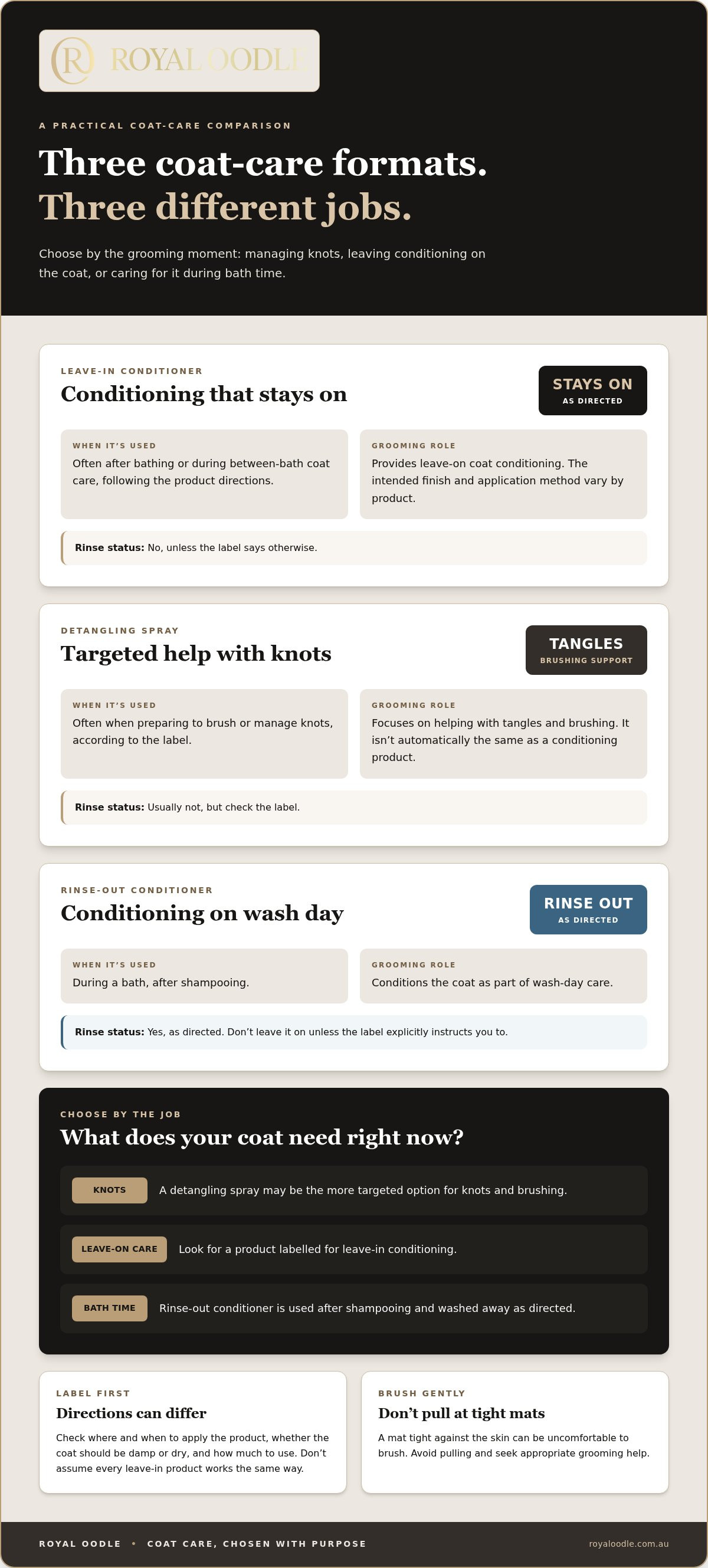
These formats can all support coat care, but they’re designed for different moments in a grooming routine. If you’re choosing leave in conditioner for dogs, start with the task: are you working through knots, looking for conditioning between baths, or caring for the coat during bath time?
| Product format | When it’s used | Rinsed out? | Grooming role |
|---|---|---|---|
| Leave-in conditioner | As directed, often after bathing or during between-bath coat care | No, unless the label says otherwise | Provides leave-on coat conditioning; intended finish and use vary by product |
| Detangling spray | As directed, often when preparing to brush or manage knots | Usually not, but check the label | Focuses on helping with tangles and brushing |
| Rinse-out conditioner | During a bath, after shampooing | Yes, as directed | Conditions the coat as part of wash-day care |
Is leave-in conditioner the same as dog detangling spray?
Not necessarily. There can be overlap: both may be used as part of coat care and may help make brushing more manageable. But formulas and directions differ. Don’t assume a detangling spray provides the same conditioning role as a leave-in product, or that every leave-in is intended specifically for knots.
Choose according to your immediate need. For knots and brushing, a detangling spray may be the more targeted option. For leave-on conditioning, look for a product labelled for that use. If you use both, check that each product’s directions suit your dog’s coat and your planned routine. For more help comparing spray options, read this guide to dog detangling sprays in Australia. Gentle brushing remains part of coat care, as outlined in VCA Animal Hospitals’ Grooming and coat care guidance.
How does leave-in conditioner differ from rinse-out conditioner?
The key difference is when each is used and whether it stays on the coat. Rinse-out conditioner is applied during a bath and washed away according to its label. A leave-in conditioner is designed to remain on the coat after application, following its specific directions.
Don’t leave a rinse-out product on your dog unless its label explicitly instructs you to do so. Product names alone don’t tell you how a formula should be used; intended use and directions matter. Choose by the grooming task, then follow the product directions. For curly and tangle-prone coats, explore Royal Oodle coat-care products.
How to compare leave-in conditioners for your dog’s coat
A useful comparison starts with your dog, not the bottle. Coat texture, where tangles form, how often you brush and what feels manageable in your routine can help you decide whether a leave-in product suits. Some owners want an ongoing coat-care step; others mainly need help with knots in specific areas, such as behind the ears or under the legs.
Use this checklist to narrow your options:
- Coat texture: Notice whether the coat is curly, wavy, fleece-textured or straighter, and how easily it catches or mats.
- Tangling pattern: Consider whether knots appear across the coat or mainly in friction-prone spots.
- Directions: Confirm the product is a leave-in, and check whether it’s intended for a damp coat, a dry coat or a particular application method.
- Your routine: Decide whether you’re after ongoing coat conditioning or targeted support while brushing.
Match the product to coat texture and tangling needs
Curly and fleece-textured coats may hold tangles differently from straighter coats, while wavy coats can vary with length and density. Longer or dense hair may need section-by-section brushing so you can work gently through the coat. A short, low-tangle coat may call for a simpler approach. Texture isn’t a strict breed rule, so observe your dog’s actual coat. For a curly, tangle-prone coat, see this guide to choosing a detangler for Cavoodles.
Regular brushing remains central, whatever the coat type. VCA Animal Hospitals notes that all dogs benefit from regular brushing. A product can complement that care, but it doesn’t replace brushing or professional grooming when your dog needs it.
Read product directions with sensitive skin in mind
Labels help you compare intended use, application area and amount. Check whether the product is genuinely leave-in, and follow its instructions for applying it to the coat. Don’t assume that a product suited to one coat or application method will suit another. If your dog has sensitive skin, read the label carefully and introduce a new product cautiously, using it only as directed.
Keep products away from the eyes, nose and mouth, and avoid irritated or broken skin unless the label specifically says otherwise. If a concerning skin reaction occurs, stop using the product and contact your veterinarian. The aim is to match the product to your dog’s coat needs, skin sensitivity and grooming routine, rather than to find a universal “best” formula.
How to apply leave-in conditioner and keep brushing comfortable
A gentle routine starts with the product label, not a one-size-fits-all method. Directions determine whether your dog’s coat should be damp or dry, how much product to apply and whether it should be spread through the coat or used on particular areas. More product than directed won’t necessarily make brushing easier.
A gentle step-by-step leave-in conditioner routine
- Read the directions. Check that the product is intended to be left in, and note the coat condition, application area and amount specified.
- Prepare the coat. Follow the label’s instructions for damp or dry hair. If the coat needs to be separated for brushing, do so gently before applying the product.
- Apply as directed. Work carefully and keep the product away from your dog’s eyes and mouth. Don’t apply it to irritated or broken skin unless the label specifically permits this.
- Brush in small sections. Use a tool suited to your dog’s coat. Start at the ends of a tangle and ease through it gradually, supporting the hair near the skin rather than pulling.
Watch your dog’s body language as you go. If they move away, tense up or show signs of discomfort, pause and give them a break. A short, calm session is preferable to forcing the brush through a knot. Remember: follow the label, apply only as directed and brush gently in manageable sections.
Using a leave in conditioner for dogs can be one part of coat care, but it doesn’t replace routine brushing. Let your dog set the pace and keep each session calm and unhurried.
When to adjust the routine or seek help
If the coat feels sticky, coated or harder to brush after application, pause and review the directions and amount used. Don’t keep adding product to compensate. The formula may not suit the task, or the coat may need a different approach. Adjust only in line with the label.
Persistent or tight mats can be uncomfortable, especially when close to the skin. Don’t repeatedly pull at them or rely on excess product to loosen them. A professional groomer can assess whether the mat can be safely managed. Ongoing irritation, skin changes or discomfort aren’t simply grooming problems, so stop using the product and seek veterinary advice.
For a considered at-home routine, explore coat-care products for curly coats from Royal Oodle.
Build a simpler curly-coat routine with Royal Oodle
The most manageable routine suits your dog’s coat and gives each step a clear purpose. Choose a product format for the grooming task, then follow its label. A leave in conditioner for dogs may be one option for coat care, while a detangling spray can help when brushing is the focus. Neither needs to become an extra step unless it fits your dog’s needs.
Where leave-in care fits between bath days
Think of bath-day care and between-wash care as separate parts of the routine. At bath time, shampoo cleanses and rinse-out conditioner is used and removed as directed. Between washes, regular brushing helps you keep an eye on tangles. A detangling spray may support brushing when its directions suit the coat and task. A leave-in product can be considered for between-bath care if its label describes that use.
Keep the routine purposeful. You don’t need to layer products simply because they’re available. Check each label for where and how to apply the product, whether the coat should be damp or dry, and how often it’s intended to be used. If your dog’s coat feels difficult to manage, review your brushing approach and product directions before adding another step.
Explore coat care designed for curly-coated dogs
Oodles and other curly-coated dogs need a coat-care routine that takes their texture and brushing needs into account. Royal Oodle’s Australian-developed and manufactured range includes detangling sprays, shampoos, conditioners and grooming kits designed for curly coats. Each format has a different role: cleansing at bath time, conditioning as directed, or supporting detangling during brushing.
Start with the task in front of you. For bath-day care, follow the directions for shampoo and conditioner. For knots between washes, use a detangling spray according to its label. If you’re considering leave-in care, choose a product specifically intended to remain on the coat and use it as directed. Keep brushing gentle and consistent, and adapt the routine to your dog’s coat rather than following a rigid schedule.
Explore Royal Oodle coat care to find grooming products suited to curly-coated dogs and build a simpler at-home routine.
Make coat care feel more manageable
The right grooming product depends on the task, your dog’s coat and the label directions. A detangling spray may suit knot-focused brushing, while leave in conditioner for dogs is an option when you’re looking for leave-on coat care. Rinse-out conditioner belongs in the bath routine and should be used as directed.
Keep the routine gentle and purposeful: choose products for your dog’s needs, apply them as instructed and make regular brushing a calm part of your time together. For Oodles and other curly-coated dogs, Royal Oodle’s Australian-developed and manufactured range brings together detangling sprays, shampoos, conditioners and grooming kits for considered at-home coat care.
Explore Royal Oodle coat care to find products for a routine that suits your dog. A few thoughtful steps can make grooming feel less like a chore and more like a comfortable ritual you share.
Frequently Asked Questions
Is leave-in conditioner safe for dogs?
A leave-in conditioner made for dogs may be suitable when used exactly as directed, but no product suits every dog. Read the label for application instructions and cautions, and take extra care if your dog has sensitive skin. Keep it away from the eyes and mouth. If you notice a concerning reaction, stop using the product and contact your veterinarian. Choose leave in conditioner for dogs, not a human hair product.
Can I use human leave-in conditioner on my dog?
No, it’s best not to use human leave-in conditioner on your dog. Human hair products are formulated for people, and differences in skin pH and formulation may irritate a dog’s skin. Choose a product specifically intended for dogs and follow its label directions. If your dog has a history of skin sensitivity or develops irritation, stop using the product and seek advice from your veterinarian.
What is the difference between dog leave-in conditioner and detangling spray?
Leave-in conditioner is intended to remain on the coat for conditioning, while detangling spray focuses on helping with knots and brushing. Their uses can overlap, but formulas and directions vary. Check the label to see whether it’s designed for your grooming task, where to apply it and whether it should remain on the coat. For a specific tangle, a detangling spray may be the more targeted choice.
Do you rinse leave-in conditioner out of a dog’s coat?
Usually, a leave-in conditioner is designed to stay on the coat, but the label is the guide for that particular product. Apply it as directed, including any instructions about coat condition or where to use it. Don’t assume a rinse-out conditioner can be left on instead. Rinse-out formulas are intended to be washed away during bathing unless their directions explicitly say otherwise.
How often can I use leave-in conditioner on my dog?
Follow the product label for how often to use it, as directions vary between formulas. Your dog’s coat, grooming routine and skin sensitivity may also affect what feels appropriate. Don’t apply it more frequently or use more than directed in an effort to improve manageability. If the coat feels coated or brushing becomes harder, review the instructions and pause use if needed. Ask your veterinarian about ongoing skin concerns.
Can leave-in conditioner help prevent mats in a dog’s coat?
A leave-in product may help make some coats feel more manageable during brushing, but it can’t guarantee mat prevention or replace regular brushing. Curly, long or tangle-prone coats may need consistent, gentle attention, especially in areas where hair rubs together. Work through small sections without pulling. If a mat is tight, close to the skin or painful to brush, don’t force it; seek professional grooming help.
Should I use leave-in conditioner on a puppy?
Use a leave-in conditioner on a puppy only if the product label indicates it’s suitable for your puppy’s age, and follow its directions carefully. Puppies can be sensitive to handling and new products, so introduce coat care gently and stop if you notice irritation or discomfort. If age suitability isn’t clear, or your puppy has a skin concern, ask your veterinarian before applying the product.
