

Could the kindest way to tackle a severe mat be to put down the brush? If you’re wondering how to remove severe mats from a dog, first decide whether it’s safe to handle at home. A mat that sits tight against the skin can make brushing or cutting risky, even when you’re trying to help.
It’s understandable to worry about tugging, hidden skin irritation or trapped moisture. Mats can pull painfully on delicate skin and, when extensive, may restrict your dog’s movement. You don’t have to force them out to show your dog care. Knowing when to stop is part of keeping grooming gentle.
This guide will help you assess where a mat sits, recognise when home detangling isn’t safe and understand when a groomer or veterinarian is the kinder next step. You’ll also learn how to gently loosen a small, workable tangle without pulling, what to do after mats are safely addressed and how to make routine coat care more comfortable.
Key Takeaways
- A severe mat is dense and resists gentle separation. Pulling can hurt, so assess before you begin.
- To decide how to remove severe mats from a dog, check whether you can see or safely feel where the skin begins, and watch your dog’s comfort.
- Home handling is only for loose, accessible tangles with clear, comfortable skin. Tight, skin-close or widespread mats call for professional help.
- Keep any home detangling session calm and brief, with gentle handling and breaks. Stop if your dog shows discomfort or the mat resists.
- After clipping, handle exposed skin gently and seek veterinary advice for persistent redness, sores, swelling or signs of pain.
Severe mats in dogs: why safety matters before you start
A severe mat is a dense, compacted knot that resists gentle separation and may sit close against your dog’s skin. Unlike a loose tangle, it can pull on the skin with even small movements. Repeated brushing or tugging may cause pain and make your dog wary of future handling. Mats can also conceal the skin, making it hard to spot irritation or judge how close the knot is to the body.
Curly coats can tighten around loose hair. Friction-prone spots such as behind the ears, under the collar, in the armpits and between the legs can mat quickly. General dog grooming practices include brushing to help prevent knots, but that isn’t a reason to force a brush through a compacted mat. Before deciding how to remove severe mats from a dog, put comfort and visibility first.
How severe matting differs from an ordinary tangle
A loose, surface-level tangle usually separates with gentle finger movement and doesn’t tug at the skin. A severe mat feels firm or felted, holds together when you try to part the coat, or seems anchored close to the body. Tight curls and friction can make it harder to judge where the hair ends and the skin begins.
Size alone doesn’t tell you whether a mat is safe to work on. A small knot can be tight against delicate skin, while a larger tangle may sit loosely in the coat. If you can’t see or safely feel where the skin begins, don’t try to work underneath the mat. Never yank, force a brush through it or cut blindly. A dog’s skin may be drawn into the knot and can be difficult to distinguish from fur.
Signs your dog needs help rather than another brushing session
Pause at the first sign that your dog is uncomfortable. Flinching, crying, turning to guard the area, moving away or being unable to settle are clear reasons to stop. Don’t interpret stillness as permission to continue if your dog seems tense or is trying to avoid your hands.
- Skin you can’t assess: The mat hides the skin, or you can’t tell how close it sits to the body.
- Possible skin concerns: You notice redness, broken skin, swelling, discharge or a strong odour. These signs warrant veterinary attention, rather than more brushing.
- Discomfort or reduced movement: Your dog reacts when the area is touched, or the matting appears to limit walking, sitting or using the toilet comfortably.
Extensive, painful or movement-restricting mats need prompt in-person assessment, not a longer home grooming session. A groomer can assess whether clipping is the gentler approach. Contact a veterinarian promptly if the skin looks damaged or inflamed, there’s discharge or swelling, or your dog appears to be in pain. The goal isn’t to remove every knot yourself. It’s to recognise when stopping is the kindest next step.
How to assess a dog’s mats before attempting removal
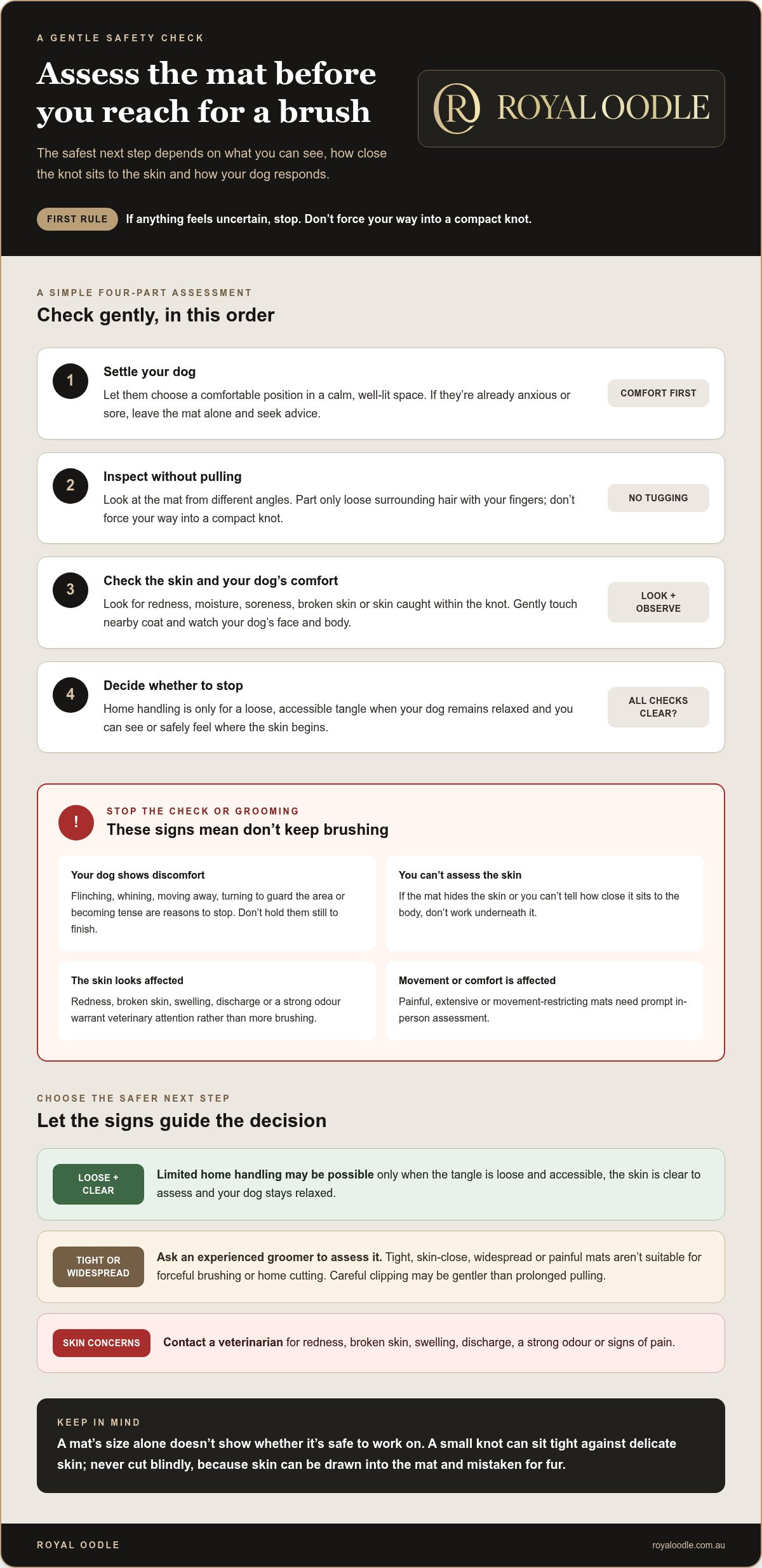
Before deciding how to remove severe mats from a dog, assess the coat and your dog, not just the knot. A quick check can help you recognise when gentle home handling may be possible and when continuing could cause distress. Don’t begin with a brush or scissors. First, create a calm, well-lit space where your dog can stand or lie comfortably without being restrained.
Check the mat, the skin and your dog’s comfort
Follow this short sequence, and stop as soon as something feels uncertain:
- Settle your dog. Let them choose a comfortable position. If they’re already anxious or sore, leave the mat alone and seek advice.
- Inspect without pulling. In good light, look at the mat from different angles. Part only loose surrounding hair with your fingers. Don’t force your way into a compact knot.
- Check the skin and comfort. Look for redness, moisture, soreness, broken skin or skin caught within the knot. Watch your dog’s face and body as you gently touch nearby coat.
- Decide whether to stop. Proceed only if the tangle is loose and accessible, your dog remains relaxed, and you can see or safely feel where the skin begins.
A dog may show discomfort by flinching, moving away, turning to guard the area, whining or becoming tense. Don’t hold them still to finish the check. Stress or pain means stop, give them space and choose a safer next step.
Clear rule: If you can’t see clearly where the skin begins, don’t use scissors. Skin can be drawn into a tight mat and mistaken for hair.
When a home attempt is not appropriate
Leave mats alone if they’re packed close to the skin, widespread, painful to touch or so dense that you can’t assess the skin underneath. These aren’t suitable for forceful brushing or home cutting. A small-looking knot can still be tight to the skin, so don’t use its size as your only guide.
An experienced groomer can assess whether careful clipping is the safest way to release a tight mat. Depending on how close it sits and how much coat is affected, they may need to clip the area close to the skin rather than try to detangle it. That can be gentler than prolonged pulling, but the decision depends on the coat and your dog’s comfort.
If you notice redness, broken skin, swelling, discharge, a strong odour or signs of pain, contact a veterinarian for advice. Skin concerns need attention beyond coat removal. Once the mats have been safely addressed and the skin is comfortable, gentle routine care can help maintain the coat. A dog detangling spray may be part of that ongoing routine, not a solution for tight, skin-close mats.
Home removal or professional clipping: what is safest for severe dog mats?
The safest choice depends on whether the knot releases gently, how close it is to the skin and how your dog responds to touch. Home detangling is for loose, accessible tangles only. Tight, painful or widespread matting is a reason to stop and arrange an in-person assessment, rather than try a stronger tool or a longer session.
| What you find | Safer next step |
|---|---|
| Small, loose surface tangle; skin is visible and your dog is comfortable | A brief, gentle home attempt may be reasonable. Stop if it resists. |
| Dense, tight, skin-close or widespread mats; skin is hidden or your dog reacts | Don’t brush or cut at home. Arrange assessment by an experienced groomer. |
| Redness, broken skin, swelling, discharge or signs of pain | Seek veterinary advice about the skin concern. |
When gentle home detangling may be reasonable
Consider a limited attempt only for a small knot that sits on the coat’s surface, separates easily with your fingers and leaves the skin clearly visible. Keep your dog settled and work gently for a short time. If the knot holds firm, your dog shifts away or you feel you need to pull, stop. This approach is not a way to remove severe mats.
That boundary matters. A detangling spray may support routine coat care after matting has been safely addressed, but it can’t make a dense, skin-tight mat safe to work through at home. Don’t use scissors as a quick fix. Skin can be pulled up into a mat, making it difficult to tell hair from skin. A cut made without a clear view could injure your dog.
Why severe mats may need clipping by a professional
When a mat sits close to the skin, trying to tease it apart can tug repeatedly on a sensitive area. A professional can assess whether clipping is the gentler option and work with suitable equipment and visibility. The coat may need to be clipped close where matting prevents safe access. The length left will depend on the matting and what can be reached safely.
Clipping can change your dog’s appearance, but comfort and safe access come first. If mats are extensive, painful or affect movement, arrange an in-person assessment instead of attempting removal yourself. A groomer can assess the coat. Contact a veterinarian if the skin appears injured, inflamed or infected, or your dog seems to be in pain. The practical answer to how to remove severe mats from a dog may be to leave the clipping to someone equipped to assess the coat safely.
A gentle, limited home method for loose mats, and when to stop
This method is only for small, loose, accessible tangles where the skin is clear and your dog is comfortable. It isn’t a way to remove dense or skin-tight mats. If you can’t see where the skin begins, leave the knot alone and arrange an in-person assessment.
Steps for a small, loose tangle
Keep the session calm and brief. Choose a quiet spot with good light, and let your dog settle in a position that doesn’t strain the area. Keep your tools nearby so you don’t need to move or hold your dog in place mid-session. Take breaks, and finish before your dog becomes restless.
- Look before touching. Check that the tangle is loose, on the coat’s surface and separate from the skin. If it hides the skin or feels compacted, stop here.
- Start with your fingers. Gently tease apart the outer edge of the tangle, working towards the centre. Don’t pull the knot away from the body or tug at hair close to the skin.
- Support the coat. If your fingers aren’t enough, hold the coat between the tangle and the skin without pinching or pulling. This can reduce movement at the roots while you carefully work on the loose ends.
- Use a suitable brush only if it glides. Make light strokes from the outer edge, checking your dog’s response as you go. Never force a brush or comb through resistance.
- Pause and reassess. Stop if there’s pain, resistance, stress, hidden skin or no gentle progress. Don’t keep trying in the hope that more time or pressure will loosen it.
There’s no need to finish every tangle in one sitting. A calm pause is kinder than turning a short grooming moment into a struggle. If your dog flinches, moves away or becomes tense, let them go and don’t restrain them to continue.
Tools and actions to avoid on severe mats
Scissors are not a safe shortcut for dense mats. Skin can be trapped or pulled up inside the knot, where it’s difficult to distinguish from hair. Don’t use scissors, shaving tools, dematting blades or forceful combing to tackle severe matting at home. These methods can bring a sharp edge or strong pressure close to skin you can’t see clearly. Leave tight or widespread mats for an experienced groomer to assess. Contact a veterinarian if you’re concerned about the skin.
A heavily matted coat can become more difficult to manage when wet, so don’t bathe your dog to loosen severe knots. Seek advice from an experienced groomer before washing if the coat is heavily matted. Once mats have been safely addressed, a dog detangling spray can be part of routine coat care. Explore dog detangling sprays for ongoing coat maintenance, not for loosening severe, skin-tight mats.
After severe mats are removed: support the coat with gentle care
Once severe matting has been safely addressed, give your dog time to adjust. Clipping can leave skin more exposed than usual, and the area may feel sensitive. Keep handling light, follow the groomer’s or veterinarian’s aftercare instructions, and resist the urge to brush straight away. A quiet check-in and a comfortable place to rest can make the transition gentler.
The first days after clipping or mat removal
Follow the professional’s advice on keeping the clipped area clean and dry. Avoid vigorous brushing over newly exposed or tender skin, and don’t apply grooming products to irritated skin unless your veterinarian advises it. If your dog is uncomfortable, minimise handling and observe the area without rubbing or probing it.
Watch for changes rather than assuming any sensitivity is normal. Persistent or worsening redness, sores, swelling or signs of pain warrant veterinary advice. Contact a veterinarian if you notice these symptoms, or if your dog seems increasingly uncomfortable. Early attention helps you respond to a skin concern instead of trying to solve it with more grooming.
Build a lower-friction coat-care routine
Once your dog is comfortable and the skin is settled, reintroduce brushing gradually. Choose a calm moment, work in small sections and keep the touch light. Pause if your dog tenses or moves away. For curly-coated dogs, regular, gentle attention to friction-prone areas can help you spot a small knot before it compacts, without turning coat care into a lengthy session.
Products designed for curly coats, including detangling sprays and conditioners, can support routine coat care and make everyday detangling more manageable. Use them to maintain the coat after severe mats have been safely addressed, not to loosen dense, skin-tight knots. A consistent routine with products suited to your dog’s coat can make everyday care more manageable.
Keep the routine comfortable and consistent. Check behind the ears, around the collar and under the legs during relaxed handling, where friction can encourage tangles. If you find a tight knot or your dog reacts, stop and reassess rather than pushing through. Understanding how to remove severe mats from a dog includes knowing that gentle aftercare and prevention begin only once the immediate matting has been safely dealt with.
For ongoing care, explore Royal Oodle’s coat-care products for curly-coated dogs, including detangling sprays, shampoos and conditioners. Choose a gentle routine that suits your dog’s coat and comfort.
Make the next grooming moment gentler
Your next step doesn’t need to be another attempt at a stubborn knot. Give your dog time to feel comfortable, then make coat care a calm, familiar part of your routine. If you’re still unsure how to remove severe mats from a dog, choose an in-person assessment over pulling or cutting at home. Protecting your dog’s trust matters as much as caring for their coat.
Once any severe matting has been safely addressed, gentle everyday care can help you stay ahead of new tangles. Royal Oodle creates Australian-developed and manufactured grooming products for Oodles and other curly-coated dogs, including detangling sprays, shampoos, conditioners and grooming kits.
Explore Royal Oodle’s gentle coat-care range and find thoughtful options for your dog’s ongoing routine. Small, comfortable grooming moments can help make coat care feel more like a shared ritual than a struggle.
Frequently Asked Questions
Can you remove severe mats from a dog at home?
Only loose mats with clearly visible skin and a relaxed dog may be gently handled at home. If the knot is dense, painful, widespread or close to the skin, arrange an in-person assessment instead. For how to remove severe mats from a dog safely, the deciding factor is whether the coat can be managed without discomfort, not which product or tool you have. Stop if the mat resists, and never pull or cut blindly.
Should I cut a matted clump out of my dog’s fur?
No. Avoid scissors because a tight mat can pull skin into the clump, making it hard to tell where fur ends and skin begins. Even if the mat looks small, you may not be able to see what lies beneath it. A professional groomer can assess dense mats and clip them more safely. If you notice redness, broken skin or pain, seek veterinary advice rather than trying to cut the mat away.
Should I bathe my dog before removing severe mats?
Don’t rely on a bath to loosen severe matting. Water can make some heavily matted coats harder to work through, and washing isn’t a substitute for assessing the knots first. If mats are dense or close to the skin, get professional guidance before bathing. After clipping, follow the groomer’s or veterinarian’s instructions about washing and care, as the newly exposed skin may need gentle handling.
Will a groomer need to shave a dog with severe mats?
Clipping may be the safest way to release mats that sit close to the skin, but there’s no single finish that suits every dog. The amount of coat removed depends on the mats’ severity and location, and on what can be accessed safely. Let comfort guide the decision rather than aiming to preserve a particular length. A groomer can assess the coat and explain the safest approach for your dog.
Can severe mats hurt a dog even if they look small?
Yes. A mat’s appearance doesn’t show how tightly it pulls or whether skin is caught underneath. Watch your dog’s response as you approach the area: flinching, guarding, redness or reluctance to move are reasons to stop handling it. For example, a small knot under a leg may be uncomfortable when your dog walks. If your dog reacts, don’t keep brushing; arrange an appropriate in-person assessment.
Can I use detangling spray on a severely matted dog?
A detangling spray is for routine coat care, not a way to make a dense, skin-tight mat safe to pull or brush out. For severe matting, prioritise an assessment and safe removal instead of adding product and continuing to tug. Once the coat is comfortable again, a suitable spray may support gentler ongoing detangling. Stop if your dog shows discomfort, and follow professional guidance if the skin is tender or irritated.
