

What if the gentlest Oodle groom starts with doing less, not rushing through every step? If you’re searching for at home dog grooming oodle advice, it’s natural to worry about tugging at knots, making tangles worse or missing an important part of the routine. Oodle coats vary: curls, waves and straighter textures each need a slightly different approach.
A calm, repeatable routine can make care more comfortable for both of you. This guide covers setting up a relaxed grooming space, brushing, washing and drying with your dog’s coat in mind. You’ll also learn when to change your approach, when to pause and when it’s kinder to seek professional grooming or veterinary advice.
Start with small, unhurried sessions and let your dog’s comfort set the pace. The steps below can help you make home coat care a considered ritual, without treating every Oodle as if their coat were the same.
Key Takeaways
- Shape at home dog grooming oodle care around your dog’s coat texture and comfort, rather than following a one-size-fits-all checklist.
- Prepare a calm space, keep the session manageable and look over your dog’s coat and skin before you begin.
- Follow a gentle sequence from coat check and brushing through washing, rinsing and careful drying.
- Pause if your dog repeatedly avoids grooming or shows clear discomfort. Don’t pull at knots or cut close to the skin.
- Use detangling sprays, shampoo, conditioner and grooming kits thoughtfully as part of a repeatable home-care routine.
Why home grooming matters for an Oodle’s comfort and coat
You don’t need to master every grooming task in one afternoon. Begin with short, calm sessions to learn what your dog tolerates and what their coat needs. The aim of at home dog grooming oodle care is to make everyday maintenance part of your dog’s routine, not to turn your home into a salon.
Routine maintenance supports coat comfort; a full groom may involve specialist clipping and other tasks best left to a professional. Brushing, washing and drying can be part of home care, while a professional groomer can handle tasks you’re not equipped or comfortable doing. The two approaches can complement each other.
What makes Oodle coats need a considered routine?
Oodles don’t all have the same coat. Some are curly, some wavy, and others have a softer, fleece-like texture. These descriptions are useful starting points, not a precise grooming prescription. Even dogs with similar-looking coats can differ in density, length and how readily their hair tangles. Observe your own dog rather than relying on a breed label alone.
Oodles are Poodle mixes, but coat traits can vary between individual dogs and across different crosses. The Poodle is known for its distinctive coat and traditional clips. That heritage offers context, not a guarantee that every Oodle’s coat will behave the same way. Movement can bring hairs together where the coat rubs against itself, bedding or a harness. Notice where your dog’s coat changes in texture and how they respond to being handled.
What home grooming can, and cannot, do
Gentle home care helps you stay familiar with your dog’s coat and keep routine tasks manageable. It can include:
- Brushing accessible areas as part of regular coat care.
- Washing with dog-appropriate shampoo and conditioner.
- Drying carefully, while paying attention to your dog’s comfort.
These tasks can’t guarantee a mat-free coat. Coat condition changes with length, texture and daily activity, and a routine that suits your dog now may need adjusting later. Consistency supports comfort, but it can’t prevent every tangle.
Leave difficult tangles alone rather than pulling, forcing a brush through them or cutting close to the skin. Skin can move beneath the coat, making close cutting risky, particularly when a tangle is tight. If you can’t work through it gently, pause and seek help from a professional groomer. If you notice a skin concern, consult your veterinarian.
Think of home grooming as attentive maintenance, not a test of your skill or a replacement for every professional task. Start with what feels calm and manageable for your dog. Their coat, behaviour and comfort are your best guides to a routine that works for both of you.
Prepare your Oodle, coat and grooming space before you begin
A little preparation can make grooming feel more settled before you pick up a brush. You don’t need an elaborate setup or a perfectly still dog. Choose a manageable task, check what your Oodle is comfortable with and have everything within reach. If they’re new to handling, let them get used to your touch before attempting a longer session.
Before grooming, check your dog’s comfort, look over their coat and skin, gather suitable tools, and set up a calm space with everything close at hand.
- Choose a quiet area with enough room for you and your dog to move comfortably.
- Set out the coat-care tools, towels and products you plan to use.
- Keep the session manageable by focusing on one task or area if needed.
- Notice how your dog responds to gentle handling before you begin.
Before brushing or bathing, visually inspect the coat and any exposed skin. Look for areas that seem unusually tangled, redness, swelling, cuts or anything else that concerns you. This is an observation, not a diagnosis. If you see a worrying change or your dog seems sore, leave that area alone and seek veterinary advice rather than grooming over it.
Choose tools for the coat you can see
There isn’t one brush that suits every Oodle. Consider your dog’s coat texture, length and density, then choose gentle tools that feel manageable in your hand. A suitable tool should move through accessible areas without force or painful pulling. For more guidance on selecting equipment, the curly dog coat care kit guide explores what to consider before choosing a kit.
Test your approach gently on an easy-to-reach area, paying attention to your dog as well as the coat. If the tool catches, pulls or makes your dog flinch, stop and reassess instead of applying more pressure. Your setup should support a light touch, not make you feel you need to push through discomfort to get a result.
Make the grooming space feel calm
Prepare first, then bring your dog into the space. Keep towels, products and tools close so you don’t need to leave your dog unattended on a raised or slippery surface. Choose a stable setup that suits your dog’s size and your confidence. If a table feels unsafe, a non-slip floor space may be more comfortable.
Keep your pace reassuring and build in pauses. Your dog might be happy to have their back brushed but uneasy about their paws or face. Leave those areas for another time if needed. A short session that ends calmly is more useful than trying to finish every task at once. Royal Oodle’s coat-care products and kits include options to consider as you organise a routine around your dog’s needs.
How to groom an Oodle at home: a gentle step-by-step routine
A simple sequence gives you a clear path without assuming every Oodle’s coat or tolerance is the same. Move at your dog’s pace, adapt your touch to the coat you see and treat each step as an opportunity to check how they’re feeling. You don’t have to complete the whole routine in one session.
- Check the coat. Look over the areas you can see and gently feel for tangles or spots that seem uncomfortable. If a knot feels tight or close to the skin, don’t force your fingers or a tool through it.
- Brush gently. Work through manageable sections with light strokes that don’t tug. Adjust your approach for the coat’s texture and length. If your dog pulls away, flinches or seems unsettled, stop and give them a break.
- Wash thoughtfully. Wet the coat gently, then apply dog shampoo according to its label. Keep the process calm and take care around sensitive areas. If you use conditioner, follow its label directions too.
- Rinse thoroughly. Work carefully through the coat, checking that the water runs clear and no shampoo remains. Take your time around thicker areas, where product can be harder to rinse away.
- Dry with care. Press a towel gently against the coat to absorb water rather than rubbing vigorously. Continue drying in a way your dog tolerates, and pause if they become distressed or you can’t manage the coat comfortably.
Brush and wash without rushing
Brushing in smaller sections helps you notice how the coat responds, rather than relying on force to make progress. A wavy coat and a curlier coat may need different handling, so keep strokes gentle and change your approach if the tool catches. For detailed breed-specific wash-day guidance, the Cavoodle grooming routine offers a focused reference. Use it as a companion, not a substitute for observing your own dog.
During washing, follow the shampoo label for application and use. Rinsing well is an important part of the routine, as lingering product can leave the coat feeling less clean. Work patiently through the coat without scrubbing hard or assuming the same method suits every dog. If your Oodle finds water or handling difficult, pause and return to the task when they’re more settled.
Rinse and dry with care
After rinsing, gently separate the coat with your hands and check for areas that still feel slippery or soapy. Towel-dry with light pressure, especially where the coat is dense or your dog is sensitive to touch. If you use a dryer, continue only if your dog remains comfortable, and keep the airflow and handling gentle. Stop if they show distress. A calm pause matters more than finishing quickly.
This routine is a guide, not a test to pass. If a tangle won’t release without pulling, or drying becomes difficult to manage, stop and seek appropriate professional grooming advice. An incomplete, comfortable session is better than pushing your dog through distress. For dog coat-care products to support your routine, explore Royal Oodle grooming products.
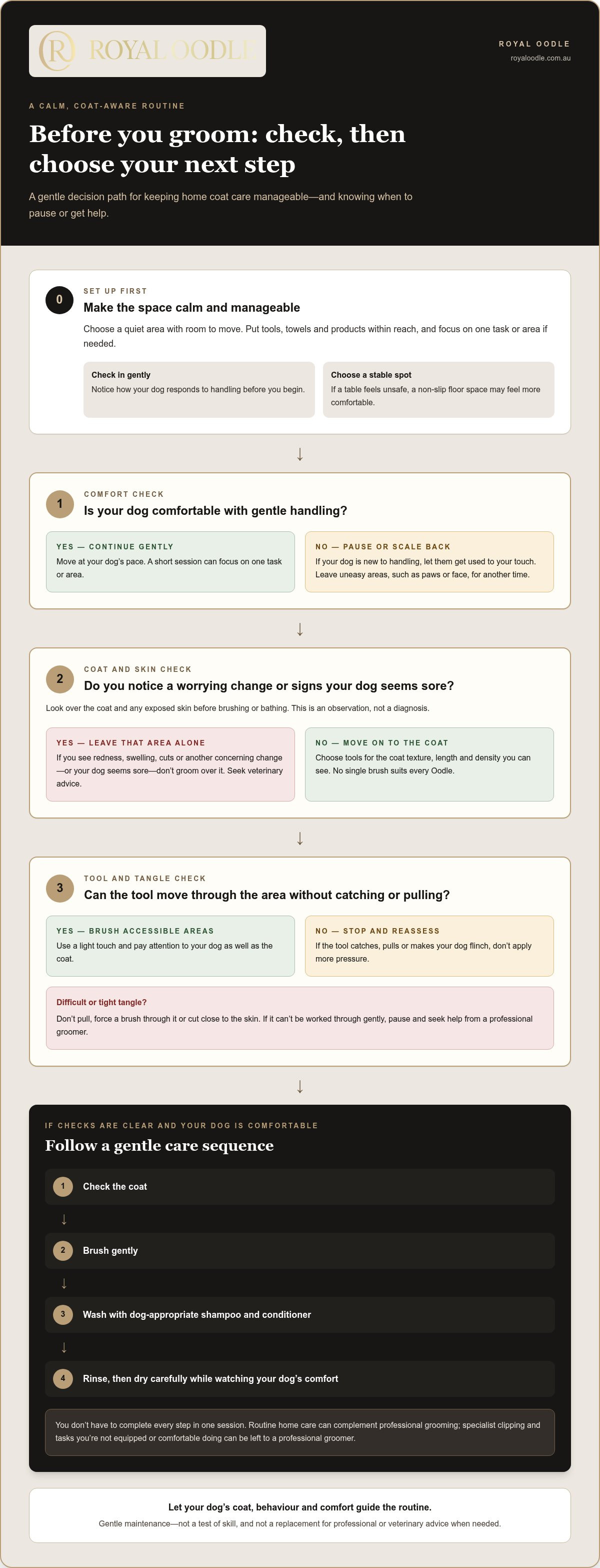
How to keep home grooming comfortable, and when to pause
Your Oodle’s comfort is the best guide to whether a grooming task should continue. Don’t pull through a knot, persist when your dog is distressed or cut close to the skin. Stop and reassess instead. A calm pause helps protect trust and distinguish routine coat care from a task that needs more experience.
Notice what your dog is doing, not just how the coat looks. Repeatedly turning away, pulling a paw or their body out of reach, flinching, stiffening, whining or trying to leave are observable reasons to stop. One brief movement may simply be a response to handling, but repeated avoidance or clear discomfort means the session needs a pause. Give your dog space and don’t restrain them to finish a non-urgent task.
What to do when brushing meets resistance
A loose, small tangle may move with the surrounding coat, while a tight mat can feel dense, compact or close to the skin. If gentle contact meets resistance, don’t increase pressure or keep brushing to test it. Put the tool down, allow your dog to settle and reassess without tugging. Return to routine care only when your dog is comfortable and the coat can be handled gently.
Resistance can come from the coat, the handling or simply your dog having had enough for now. You don’t need to work out the cause before stopping. If a knot won’t yield to light contact, or you can’t tell how close it sits to the skin, leave it alone. Cutting it out is not a safe shortcut because skin can be difficult to see beneath a dense coat.
When a task is better left to an experienced professional
Close-to-skin mats, tangles in sensitive areas and trimming you’re unsure how to do are good reasons not to improvise. A professional groomer can advise on coat work that goes beyond your confidence. Home care can support comfort between professional appointments, but it can’t guarantee that tangles won’t form or replace every grooming task.
Keep skin concerns separate from coat styling. If skin looks irritated or injured, or your dog remains uncomfortable when you’re not grooming, stop handling the area and seek veterinary advice. Don’t try to diagnose the cause or cover a concern with grooming products. A veterinarian is the appropriate person to advise on health concerns; a groomer can help with coat management.
Use this simple decision check before continuing:
- Comfortable and manageable: continue gently, watching your dog’s response.
- Repeated avoidance or clear discomfort: pause and give your dog a break.
- Tight mat, sensitive spot or uncertain trim: stop and seek suitable grooming help.
- Irritated, injured or persistently uncomfortable skin: seek veterinary advice.
Choose a calm, considered routine over a perfectly finished coat. For gentle coat-care products to support your home routine, explore Royal Oodle grooming products.
Build an Oodle grooming routine with thoughtful coat-care products
A useful routine is one you can repeat without making grooming feel like a major production. Shape it around your Oodle’s coat, comfort and household schedule. A curly coat may need different attention from a looser wave, while your dog’s tolerance can determine whether care happens in one session or several. Keep the essentials simple and adjust as you learn what works.
For at home dog grooming oodle care, think of products as support for specific steps, not a promise of a particular result. Brushing can be a regular maintenance task, followed by washing when needed, rinsing and careful drying. If your dog finds a step uncomfortable, pause rather than adding more products or pressure.
Match product categories to the grooming step
Shampoo and conditioner belong in the washing part of the routine. Choose dog grooming products and follow each label’s directions. A detangling spray is a separate coat-care option for brushing, used according to its directions. It isn’t a reason to force a tight knot. The Australian curly dog grooming products guide provides broader context for thinking about coat-care choices.
Grooming kits and bundles can bring together products or tools for a home routine. Their usefulness depends on what you actually need and feel confident using, not how many items are included. A kit shouldn’t encourage you to attempt trimming or difficult dematting beyond your experience. Keep veterinary advice separate from product selection if you have concerns about your dog’s skin.
Make the routine easier to repeat
Build a light rhythm that fits your week. For instance, set aside a quiet moment for brushing, then plan washing for a time when you can rinse and dry without rushing. The right balance varies with your dog’s coat and response to handling, so let those guide your routine rather than following a rigid schedule. A dog grooming bundle guide can help you understand what to consider when comparing kit options.
Royal Oodle is an Australian privately owned brand, and its grooming range is developed and manufactured in Australia. It includes detangling sprays, shampoos, conditioners, bundles and kits, with gentle formulations for sensitive skin. Explore Oodle coat-care products to find options that fit the steps you’re comfortable doing at home.
Most of all, treat grooming as attentive care, not a perfection test. Your routine can change as your dog’s coat, comfort and needs change. Small, calm sessions count, even when you stop before every task is done.
Make your next grooming session a gentle start
Your next step doesn’t need to be a full wash day. Choose one calm moment to practise a small part of your routine, then notice what your Oodle accepts comfortably. That observation can help you shape at home dog grooming oodle care around the dog in front of you, rather than an idealised checklist.
Keep your approach flexible. A change in coat condition, household rhythm or your dog’s response may call for a different pace. If a task feels beyond your confidence, pausing is a thoughtful choice, not a setback. Grooming should support your dog’s wellbeing, with professional help for coat tasks that need experienced handling and veterinary advice for skin or health concerns.
When you’re ready to choose products for your routine, explore Royal Oodle’s detangling sprays, shampoos, conditioners, bundles and kits. Explore Royal Oodle coat-care products and choose options for your Oodle’s care.
Let comfort guide the process. With patience and a routine that suits your dog, each gentle session can be a little easier to approach.
Frequently Asked Questions
Can I groom my Oodle at home?
Yes, you can handle routine at home dog grooming oodle care if your dog is comfortable and the task is within your confidence. For example, you might maintain the coat between professional appointments without attempting a complete style or difficult mat removal. Choose simple care you can do gently, and leave close-to-skin work or anything that worries you to an experienced groomer. Home grooming and professional care can work alongside each other.
How often should I groom my Oodle at home?
There isn’t one schedule that suits every Oodle. Coat length, texture, activity and how readily the hair tangles all affect how often you’ll need to check and care for it. Look over the coat after it’s been compressed by a harness or outdoor activity, then decide whether gentle brushing is needed. If you’re unsure how often to book a full groom, ask a professional groomer familiar with your dog’s coat.
Can I use human shampoo on my Oodle?
It’s best to use shampoo made for dogs rather than human shampoo. Human products are formulated for people, not dogs, and may not suit your Oodle’s skin or coat. Choose a dog shampoo and follow its label directions, rinsing thoroughly. If you’ve already used human shampoo and notice redness, persistent scratching or other irritation, stop using it and contact your veterinarian for advice.
Should I brush my Oodle before or after a bath?
Brush before the bath, provided you can do so without pulling or discomfort. Water can make existing tangles harder to manage, so check the coat while it’s dry and address only what moves easily with gentle brushing. Don’t try to work through a tight mat. After washing, handle the coat carefully while drying and wait until it’s dry before checking whether any loose tangles remain.
Can I trim my Oodle’s coat at home?
You can trim only if the task is simple and you’re confident using the tools safely. Avoid cutting close to the skin, around sensitive areas or into a mat, as it can be difficult to see where the skin lies beneath the coat. If your dog moves suddenly, resists handling or you’re unsure how to shape the coat, stop and arrange help from an experienced groomer rather than improvising.
What should I do if my Oodle becomes anxious during grooming?
Stop the grooming task and give your dog space to settle. Don’t hold them still or continue while they’re trying to escape. At another time, rebuild comfort in tiny steps, such as briefly showing the brush, then rewarding calm interest without brushing. Keep these introductions short and relaxed. If anxiety appears suddenly or your dog reacts as if in pain, speak with your veterinarian.
How do I clean my Oodle’s ears at home?
Clean only the parts of the ears you can see, and use an ear cleaner recommended for your dog by a veterinarian. Apply it as directed and gently wipe the visible outer ear with a soft pad. Don’t insert cotton buds, fingers or other objects into the ear canal. If you notice discharge, an unusual smell, frequent head shaking or discomfort, leave the ear alone and seek veterinary advice.
